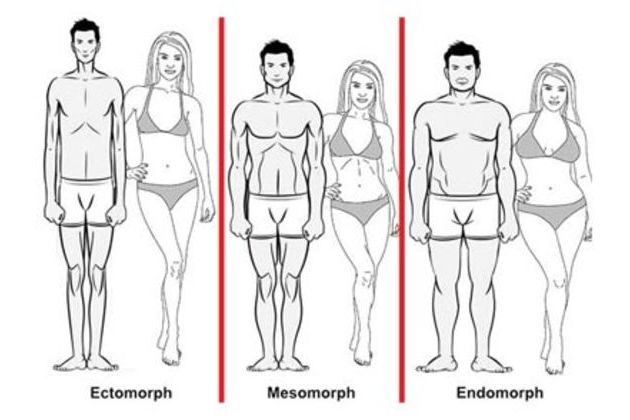
Body types
A person’s somatotype is a body type determined genetically which depends on the speed and peculiarities of metabolism, susceptibility to diseases and psychophysiological differences in temperament, which Hippocrates divided into 4 groups: sanguine, choleric, phlegmatic, and melancholic. Doctors have been working on the typology of somatotypes for thousands of years. We will list only those physique gradations that are most often used today among physiologists and doctors.
Among athletes, sports doctors and physiologists, it is common to use the typology of Harvard professor William Sheldon, who in 1940 distinguished 3 somatotypes – ectomorph, mesomorph, endomorph. In 1954, special atlases were compiled, on the basis of which an adult can be assigned to one of these somatotypes. Having determined your body type according to Sheldon, you can find out which system of eating behavior and training scheme is best for you to achieve maximum results in bodybuilding.
Ectomorph

A novice bodybuilder is a representative of this somatotype, it is easy to recognize in the gym. An ectomorph is characterized by:
- tall, but there are also ectomorphs – thin women of short stature;
- an elongated face with a high forehead and protruding chin;
- narrow and flat chest;
- thin and long legs and arms;
- underdeveloped musculature or long sinewy muscles;
- a very thin layer of subcutaneous fat.
Ectomorph is a classic hardgainer. Their naturally accelerated metabolism does not allow them to quickly gain weight and show high performance in gaining muscle mass and increasing strength.
Ectomorph training
The following recommendations will help an ectomorph bodybuilder to intensify the process of forming voluminous and relief musculature:
- Optimal load and time for recovery, which promote muscle growth – 3 strength training sessions per week. All major muscle groups should be worked on each. Heavy loads should be moderate in volume, but performed with high frequency.
- Give primary attention and most of the time to squats, pull-ups, deadlifts, bench presses, as well as exercises for simultaneous training of muscle groups in different parts of the body.
- Do not give up completely, but limit the cardio load as much as possible – 10, maximum 20-minute, but quite intense or heavy cardio sessions after strength training.
Such a scheme provides sufficient aerobic and anaerobic load, and leaves the optimal amount of time for recovery, which will help increase volume and form the desired muscle relief.
Ectomorph diet
Most ectomorphs find it difficult to gain weight and muscle mass. They are satiated too quickly and therefore malnourished, or, as a rule, have too fast a metabolism from birth. The following recommendations will help to bypass this:
- not 3, but 5-7 meals a day;
- inclusion of gainers and protein shakes in the menu even between snacks on days without training;
- snack right before bed.
An ectomorph should monitor the daily caloric content of the menu, not allowing it to be underestimated, and enrich it with fatty meats, dairy products with a higher fat percentage, peanut butter, nuts, avocados.
Endomorph

Representatives of this somatotype can be described as dense and soft. They incredibly easily increase both muscle volume and fat layer, as a result of which their muscles do not have sufficient relief. Typical for an endomorph:
- short stature;
- round head;
- big belly;
- weak and lethargic limbs with thin wrists and bones, wide knees and elbows, large deposits of fat on shoulders and thighs;
- a slow metabolism that makes getting rid of fat incredibly difficult.
The muscles of an ectomorph train well for building strength. This especially applies to the quadriceps and gluteal muscles.
Endomorph training
Adherence to the following recommendations will help to achieve positive results in endomorph bodybuilding:
- Training with weight – 4 times a week with a clear division into upper and lower.
- The optimal dosage of one exercise is 10-15 repetitions with breaks between 3 approaches, lasting 45-60 seconds.
- Inclusion of supersets of non-competitive exercises, for example, bench press, imitation of rowing, in each training session, during the drying phase.
- 3-4 full-body cardio sessions either after strength training or on the days in between. However, 1 day a week must be a day off.
Such a combination will activate the metabolism, support muscle growth and at the same time help to get rid of the fat layer.
Endomorph diet
To achieve better results, endomorphs should follow these tips:
- reduce the calorie content of the daily menu, but slightly;
- avoid starvation or strict diets;
- eat small portions equal in volume and calorie content throughout the day;
- give up junk food, fast food and street food;
- enrich the menu with protein from lean meat and fish, vegetables with a large amount of fiber;
- limit carbohydrates and alcohol.
In the period of weight gain, to compensate for the diet of meat, include one of the whey proteins in the menu.
Mesomorph

It is not for nothing that mesomorphs are called the lucky ones of the gene lottery. Their characteristics are pleasantly impressive:
- athletic physique, medium or tall height;
- cubic head;
- broad shoulders, a large volume of the chest and a narrow waist;
- muscular arms and legs;
- a small amount of subcutaneous fat;
- metabolism that allows you to easily build muscle without gaining fat.
A mesomorph is a natural athlete, and it is easier for him to win victories in bodybuilding than an ecto- or endomorph.
Mesomorph training
A mesomorph will gain muscle mass with the help of any type of training program while observing the principle of progressive loading, so he can safely experiment and choose the one he likes more.
Cardio training of the mesomorph is necessary to maintain the health of the cardiovascular system. 1-2 workouts per week between weight training sessions, or a 10-minute moderate intensity session after each weight training session is enough.
Mesomorph diet
When protein macros are included in the diet, the mesomorph can eat anything. You can even not particularly monitor the balance of intake and expenditure of calories. It is enough to eat until full to give the muscles the necessary amount of nutrients for their maintenance or growth. Periodically add one of the sports food supplements to your diet, and training and genetics will do the rest.
Conclusion
No matter what your body type is, to become an athlete with relief forms, you need not only to build muscles and burn fat, but to follow a diet that corresponds to the training period (gaining mass, drying, maintaining shape).