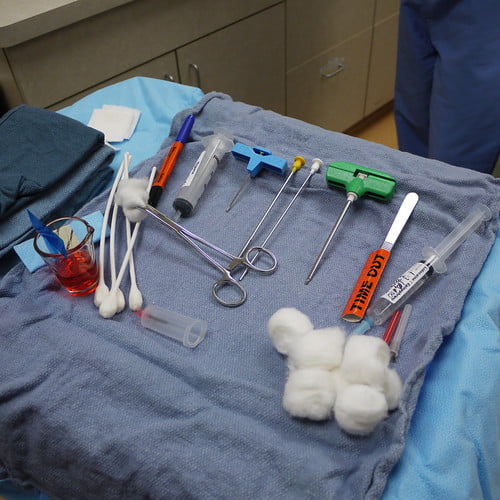
Non-Tunneled + Tunneled Hemodialysis Catheter
- Ultrasound unit + Probe cover
- Small Tray
- Micropuncture set
- Short amplatz wire (Some physicians) Small J wire (Other Docs)
- Dilators 8/10F
- Soft silk suture
- Lidocaine in control top syringe
- Heparin 1000 Units/cc
- Heparinized Saline
- Some physicians uses a ruler, dermabond and steristrips with tunneled HD catheter placement
Triple Lumen Catheter – Non Tunneled
- Ultrasound unit + Probe cover
- Triple lumen kit (contains dilator and J wire)
- Soft silk suture
- Lidocaine in control top syringe
- Heparin 100Units/cc
- Saline
Note: when passing catheter over wire for placement leave red lumen open. Prime white and blue ports with heparinized saline
Broviac – Tunneled small bore central venous catheter
- Ultrasound unit + Probe cover
- Small tray/small drape
- Micropuncture set
- Broviac Catheter (single or double)
- Soft silk suture
- Lidocaine in control top syringe
- Heparin 100Units/cc
- Hep Saline
- Some physicians uses steri strips and dermabond, Some physicians also use a glow switch
Tunneled Catheter removal
- Medium Drape
- Large laceration tray which includes 27G needle
- Control top syringe for lido
- Labels
- 4 x 4 gauze pack
- Blue towels
- Chloro prep
- Tegaderm
RFA – Saphenous vein ablation
- Ultrasound unit + Probe cover
- Large tray
- Micropuncture set
- Tumecent from inpatient pharmacy (Take RFA requisition to inpt pharmacy at least 2 hrs prior to appt)
- Saline
Venaseal – Saphenous vein ablation
- Ultrasound unit + Probe cover
- Large tray
- Micropuncture set
- Saline
- Control top syringe for lido
IVC filter placement
- Ultrasound unit + Probe cover
- Small tray
- Control top syringe for lido
- Micropuncture set
- Contrast
- Heparinized saline
- Bentson
Tunneled Central Line Exchange with Possible revision
- 1 Stiff angled 180cm Glide wire
- Large tray or small tray and a curved kelley from suture removal kit
- Control top syringe for lido
- Soft silk suture
- New hemodialysis catheter
- Heparin 1000 Units/cc
- Heparinized saline
- Possibly will need (10 or 11 F sheath, Contrast, 12mm Balloon)
AV fistulagram
- Ultrasound unit + Probe cover
- 5ml of 1000units per cc heparin
- K50 Tubing
- Small tray
- Large drape
- Micropuncture set
- Hep saline
- 100ml contrast
- 1 x 6F short sheath open (have a second one ready but not open)
- Control top syringe for lido
- Micropuncture set
- Flow switch
- Nitrix (Every Day wire)
- 3-0 stitch
- May ask for Kumpe Catheter 65cm (some physicians use glidewire and glidecath)
- If intervening may need (Insufflator (Some physicians hand inflates), balloon, stents…)
AV fistula declot
- Ultrasound unit + Probe cover
- 5ml of 1000units per cc heparin
- K50 Tubing
- Large tray + Small laceration kit for cissors
- Large drape
- Micropuncture set + (Entry needle 18G x 4cm for some doctors)
- Hep saline
- 100ml contrast
- 2 x 6F short sheath open
- Control top syringe for lido
- 5mm fogarty balloon
- Flow switch
- Nitrix (Every Day wire)
- Two 3-0 stitch
- TPA
- Insufflator open on table (some doctors hand inflates)
- Kumpe Catheter 65cm open on table
- Teratola (Open if asked for)
- If intervening may need ( balloon, stents…)
Vertebroplasty
- Small tray
- Chiba needle
- Avamax
- 30ml lidocaine
- Hep saline
- (extension tubing for numbing)
Nephrostomy tube placement
- Good Ultrasound unit + Probe cover
- Small tray
- Accu-stick
- Nitrex wire (every day wire)
- Bentson
- Chiba needle
- Control top syringe for lido
- Dr. may ask for 4F kumpe catheter
- 8F Nephrostomy tube and Uresil bag
Nephrostomy tube Exchange
- Control top syringe for lido
- Small tray
- Large Drape
- Contrast
- Bentson Wire
- 8F Nephrostomy tube and Uresil bag
Double J stent placement When pt already has a Nephrostomy tube
- Small Tray
- 5F Kumpe Catheter
- Bentson and glidewire
- Peel away sheath
Lower extremity or other arterial (Splenic) Angiogram
- Ultrasound unit + Probe cover
- Large tray
- Micropuncture set
- Hep saline (Some physicians uses heparinized flush to attach and drip into access sheath)
- 100ml contrast
- 6F 10cm Sheath
- Control top syringe for lido
- Power injector tubing
- Flow switch
- Bentson, Angled glidewire
- some physicians use 90cm pigtail catheter Some physicians uses Ominiflush
- If intervening may need ( Straight flush, navicross, road runner, 45cm sheath, rosen…)
- Minx closure, Angioseal or Starclose
Splenic Artery Angiogram and Embolization
- Same as above but add Microcatheter
- Possible coils
- 3cc seringes – 6 total with 3 marked contrast and 3 marked hep saline
Uterine fibroid embolization
- Ultrasound unit + Probe cover
- Large tray
- Micropuncture set
- Hep saline (Some physicians uses heparinized flush to attach and drip into access sheath)
- 100ml contrast
- 6F 10cm Sheath open
- Control top syringe for lido
- Flow switch
- Bentson 180, Angled glidewire 180
- Open RUC catheter and Microcatheter
- Some physicians use Angiodynamics Cobra 2 Some physicians/Other physicians use Ominiflush
- 3cc syringes for microcatheter
- Minx closure, Angioseal or Starclose
Transjugular Liver Biopsy
- Ultrasound unit + Probe cover
- Small tray
- Micropuncture set
- 50ml contrast
- Control top syringe for lido
- Transjugular liver biopsy kit
- Bentson 180
- 9F 30cm Sheath
- Dilators 7/8/10
IVC Filter Placement
- Ultrasound unit + Probe cover
- Small Tray
- Large Drape
- 50cc Contrast
- Control top syringe for lido
- Micropuncture set
- Argon Option Elite Filter Kit
IVC Filter Removal
- Ultrasound unit + Probe cover
- Micropuncture set
- Filter removal kit
- Small Tray
- Large Drape
- Control top syringe for lido
- Bentson wire
- Flow Switch
- Pigtail. Some physician do not use pigtail
Groin Pseudoaneurysm.
- Ultrasound unit + Probe cover
- Small Drape
- Towels
- Laceration kit
- Control top syringe for lido
- Micropuncture set
- Gauze pack
- Chloraprep
- 3 way stop cock
- 1 cc syringe (Additional 3 cc syringes)
- Thrombin medication kit
Ultrasound Guided Biopsy
- Ultrasound unit + Probe cover
- Medium drape
- Towels
- Control top syringe for lido
- Biopsy Tray from CT
- If 18 gauge core bx open appropriate length biopence and matching introducer
- If smaller 20 gauge core bx open appropriate length Bard
- For liver and kidney bx open Gelfoam/3 way stop cock/ 2x 5cc seringes
- For livers and kidney bx Some physicians uses a 10cm 22 gauge chiba needle