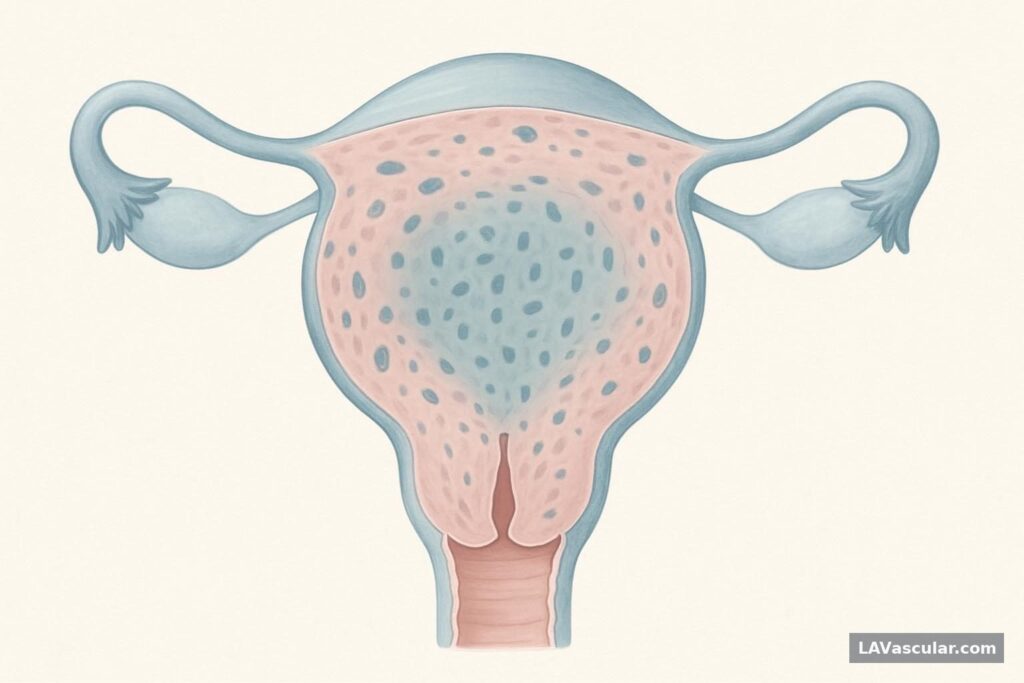
What is adenomyosis?
Adenomyosis, also called uterine adenomyosis, is a condition in which tissue similar to the uterine lining grows into the muscular wall of the uterus. It can cause heavy or prolonged menstrual bleeding, severe cramps, pelvic pressure, and an enlarged, tender uterus.
The tissue within the uterine muscle responds to monthly hormonal changes much like the normal uterine lining. This can lead to inflammation, bleeding within the muscle, uterine thickening, and pain. Adenomyosis is benign, meaning it is not cancer, but its symptoms can significantly affect work, sleep, sexual activity, and quality of life.
Adenomyosis often occurs during the reproductive years and may improve after menopause as estrogen levels decline. It can occur on its own or together with uterine fibroids, endometriosis, or both.
What types of adenomyosis are there?
Adenomyosis may be diffuse, affecting much of the uterine muscle, or focal, affecting a more limited area. The pattern can influence symptoms, imaging findings, and which treatments are practical.
What is diffuse adenomyosis?
Diffuse adenomyosis involves widespread infiltration of tissue throughout the myometrium, the muscular layer of the uterus. The uterus may become globally enlarged, rounded, and tender.
Diffuse disease is often associated with heavy periods and generalized pelvic cramping. Because it affects a broad area of the uterus, removing only one focal area is usually not an effective treatment.
What is focal adenomyosis or an adenomyoma?
Focal adenomyosis is confined to one area of the uterine wall. A localized mass-like form is sometimes called an adenomyoma.
An adenomyoma can resemble a fibroid on an ultrasound or examination, although the two conditions are different. MRI can often help distinguish focal adenomyosis from fibroids and other uterine masses.
What are the symptoms of adenomyosis?
The most common symptoms are heavy menstrual bleeding and painful periods. Some people have mild symptoms or no symptoms at all, while others develop anemia, disabling pain, or chronic pelvic pressure.
- Heavy menstrual bleeding, including clots or bleeding through pads or tampons
- Periods that last longer than usual
- Severe menstrual cramps that worsen over time
- Chronic pelvic pain or a feeling of pelvic heaviness
- Pain during sexual intercourse
- Bloating or an enlarged lower abdomen from an enlarged uterus
- Fatigue, shortness of breath, dizziness, or palpitations related to iron-deficiency anemia
- Difficulty becoming pregnant or maintaining pregnancy in some patients
Symptoms do not always match the size or extent of adenomyosis seen on imaging. A person with a mildly enlarged uterus can have substantial pain, while someone with extensive adenomyosis may have few symptoms.
What causes adenomyosis and who is at risk?
The exact cause of adenomyosis is not fully understood. It likely develops when cells similar to endometrial tissue enter or grow into the uterine muscle, influenced by estrogen, inflammation, and prior changes to the uterine wall.
Adenomyosis is more commonly diagnosed in people in their 30s, 40s, and early 50s, but it can occur at younger ages. Better ultrasound and MRI imaging have also made it easier to identify in people who previously might not have been diagnosed.
What are the risk factors for adenomyosis?
Risk factors do not guarantee that someone will develop adenomyosis. They are clinical associations that may increase the likelihood of the condition.
- Prior pregnancy, especially multiple pregnancies
- Prior uterine surgery, such as cesarean delivery, dilation and curettage, fibroid surgery, or other procedures that involve the uterine wall
- Increasing age before menopause
- Endometriosis or uterine fibroids
- Longer lifetime exposure to estrogen, although adenomyosis can occur without any known hormonal risk factor
Adenomyosis is not caused by poor hygiene, exercise, sexual activity, or cancer. It is also not contagious.
How is adenomyosis diagnosed?
Adenomyosis is usually diagnosed using symptoms, pelvic examination, and imaging, most commonly transvaginal ultrasound or pelvic MRI. A tissue diagnosis after hysterectomy is definitive, but surgery is not required simply to make the diagnosis.
The evaluation also looks for other causes of heavy bleeding or pelvic pain, including fibroids, polyps, endometriosis, pregnancy-related conditions, bleeding disorders, thyroid disease, infection, and, less commonly, precancerous or cancerous changes in the uterus.
What happens during the medical evaluation?
A clinician will ask about bleeding pattern, pain severity, pregnancy history, medications, anemia symptoms, and future fertility goals. A pelvic examination may show an enlarged, soft, boggy, or tender uterus, although a normal examination does not rule out adenomyosis.
Common tests may include:
- Pregnancy testing when appropriate
- Complete blood count to check for anemia
- Iron studies when heavy bleeding or fatigue suggests iron deficiency
- Tests for thyroid or bleeding disorders when the history suggests another cause
- Endometrial biopsy in selected patients, particularly with abnormal bleeding at an age or risk profile where uterine lining abnormalities need to be excluded
Can ultrasound diagnose adenomyosis?
Transvaginal ultrasound is often the first imaging test because it is widely available and does not use radiation. Findings can include an enlarged globular uterus, uneven muscle texture, small cyst-like spaces in the uterine muscle, and asymmetry between the front and back uterine walls.
Ultrasound may be less conclusive when fibroids are also present or when the changes are subtle. In those situations, MRI can provide more detailed information.
When is MRI used for adenomyosis?
Pelvic MRI is useful when the diagnosis is uncertain, symptoms are severe, fibroids may be present, or a uterus-preserving procedure is being considered. MRI can show the depth and distribution of adenomyosis and help differentiate diffuse disease, focal adenomyosis, fibroids, and other pelvic conditions.
MRI findings also help gynecologists and interventional radiologists discuss whether medical management, surgery, or uterine artery embolization (UAE) may be appropriate.
What are the treatment options for adenomyosis?
Treatment depends on the severity of bleeding and pain, anemia, uterine size, imaging findings, response to prior treatment, and whether pregnancy is desired now or in the future. Options include pain medication, hormonal therapy, minimally invasive uterine artery embolization, and hysterectomy.
There is no single best treatment for every person. A patient with mild symptoms may choose observation and medication, while someone with severe anemia or debilitating pain may need a more definitive approach.
Can pain medication treat adenomyosis?
Nonsteroidal anti-inflammatory drugs, or NSAIDs, can reduce menstrual cramping and may modestly reduce bleeding for some patients. Examples include ibuprofen and naproxen when medically appropriate.
Pain medication can be useful for occasional or mild symptoms, but it does not remove adenomyosis or shrink an enlarged uterus. NSAIDs may not be appropriate for people with certain kidney diseases, stomach ulcers, bleeding risks, cardiovascular conditions, or medication interactions.
Can hormonal therapy treat adenomyosis?
Hormonal therapy can reduce bleeding and pain by suppressing or stabilizing the hormonal stimulation of adenomyosis. It is often a first-line option for patients who want to avoid a procedure or who need symptom control while considering longer-term treatment.
Common hormonal options include:
- Progestin-releasing IUD: A levonorgestrel-releasing intrauterine device can reduce heavy bleeding and cramps for many patients. It remains in place for several years, depending on the device, but expulsion or difficult placement can be more likely when the uterine cavity is significantly distorted or enlarged.
- Oral contraceptives: Combined estrogen-progestin pills or progestin-only pills may reduce bleeding and cyclic pain. Some patients use them continuously to have fewer periods.
- Other progestin therapies: Oral, injectable, or implantable progestin treatments may be considered in selected situations.
- GnRH-based medicines: These medications temporarily lower ovarian hormone stimulation and can reduce symptoms, but side effects and duration limits often make them a short-term or bridging option rather than a permanent solution.
Hormonal therapy does not work equally well for everyone, and symptoms can return after treatment is stopped. The safety of estrogen-containing medications depends on age, smoking status, migraine history, blood clot risk, blood pressure, and other health factors.
What is uterine artery embolization for adenomyosis?
Uterine artery embolization (UAE), also called uterine fibroid embolization when used for fibroids, is a minimally invasive procedure that reduces blood flow to abnormal uterine tissue. It can improve heavy bleeding, pressure, and pain from adenomyosis while preserving the uterus.
During UAE, an interventional radiologist uses X-ray guidance to place a thin catheter into the uterine arteries and inject small embolic particles. The particles reduce blood flow to adenomyosis and, when present, fibroids. Over time, the treated tissue may shrink and become less active.
UAE can be considered for patients with symptomatic adenomyosis who have not had adequate relief with medication or prefer to avoid hysterectomy. It is particularly important to review MRI findings, coexisting fibroids, uterine size, infection risk, and reproductive goals before choosing this treatment.
Is hysterectomy a treatment for adenomyosis?
Hysterectomy is the surgical removal of the uterus and is the definitive treatment for adenomyosis. It eliminates menstrual bleeding and removes the adenomyosis-containing uterine muscle.
Hysterectomy may be appropriate when symptoms are severe, other therapies have failed or are unacceptable, cancer cannot be adequately excluded, or a patient does not want future pregnancy. It can be performed vaginally, laparoscopically, robotically, or through an abdominal incision depending on uterine size, prior surgery, anatomy, and other conditions.
Removing the uterus means pregnancy is no longer possible. The ovaries may or may not be removed; keeping healthy ovaries generally avoids immediate surgical menopause, while removing them causes menopause if the patient has not already reached it.
How do adenomyosis treatments compare?
The table below provides a general comparison. Individual suitability should be determined with a gynecologist and, when considering UAE, an interventional radiologist.
| Treatment | What it does | Advantages | Limitations and considerations |
|---|---|---|---|
| Pain medication | Reduces cramps and inflammation | No procedure; useful for mild or intermittent pain | Does not treat the underlying uterine changes; may not control heavy bleeding |
| Hormonal therapy | Reduces hormonal stimulation, bleeding, and pain | Often first-line; progestin IUD and oral contraceptives can be effective | Side effects, contraindications, and symptom recurrence after stopping are possible |
| Uterine artery embolization | Reduces blood supply to adenomyosis through a catheter procedure | Uterus-preserving; no large incision; may also treat coexisting fibroids | Cramping recovery is expected; future pregnancy outcomes are not fully predictable; symptoms can persist or recur |
| Hysterectomy | Removes the uterus | Definitive treatment for uterine adenomyosis and bleeding | Major surgery; recovery is longer than UAE; future pregnancy is not possible |
What should I expect from uterine artery embolization for adenomyosis?
Uterine artery embolization is usually performed by an interventional radiologist in a hospital or outpatient procedural setting. It is performed through a small artery access site, usually in the wrist or groin, rather than through an abdominal incision.
Before the procedure, patients typically have a review of ultrasound or MRI, blood tests, pregnancy testing when appropriate, and a discussion of medicines that may need to be adjusted. Active pelvic infection, suspected uterine cancer, and pregnancy generally require a different approach.
How is uterine artery embolization performed?
UAE is performed with imaging guidance, usually fluoroscopy, which is real-time X-ray imaging. Most patients receive moderate sedation and pain-control medicines; some centers use deeper anesthesia based on patient needs and local practice.
- The skin over the wrist or groin is cleaned and numbed with local anesthetic.
- A small catheter is inserted into an artery and guided under fluoroscopy to the uterine arteries.
- Contrast dye is used to map the blood vessels supplying the uterus.
- Small embolic particles are injected into each uterine artery to reduce blood flow to adenomyosis.
- The catheter is removed, and pressure or a closure device is used at the access site.
The procedure often takes about one to two hours, though timing varies with anatomy and whether fibroids are also treated. Many patients go home the same day or stay overnight for pain control and observation.
What is recovery like after UAE for adenomyosis?
Pelvic cramping is common during the first several hours and days after UAE because treated uterine tissue is losing blood supply. The care team provides a pain-control plan that may include anti-inflammatory medicine, stronger short-term pain medicine, anti-nausea medicine, and constipation prevention.
Most patients need several days away from strenuous activity and may feel tired for one to two weeks. Light walking is generally encouraged. Follow the procedural team’s instructions about driving, lifting, bathing, sexual activity, and returning to work.
Low-grade fever, fatigue, pelvic discomfort, and vaginal spotting or discharge can occur during recovery. Menstrual improvement is usually gradual over the following months rather than immediate. Follow-up commonly includes a clinical visit and, in some cases, ultrasound or MRI to assess uterine response.
Can I get pregnant after uterine artery embolization?
Pregnancy can occur after UAE, but its effect on fertility and pregnancy outcomes is not fully predictable. Patients who strongly prioritize future pregnancy should discuss all options with a gynecologist, fertility specialist when appropriate, and an interventional radiologist before treatment.
Adenomyosis itself may affect fertility and pregnancy. Hysterectomy is not appropriate for anyone who wants to carry a future pregnancy, while medication, UAE, and selected surgical approaches may be considered depending on the individual situation.
What are the complications of adenomyosis and its treatments?
Adenomyosis itself can lead to chronic pain, missed work or school, sleep disruption, sexual pain, and iron-deficiency anemia from heavy bleeding. Severe anemia may require iron treatment, urgent evaluation, and occasionally blood transfusion depending on the clinical situation.
Each treatment has its own potential complications. Discussing these risks in the context of a person’s medical history is essential.
What are the risks of uterine artery embolization?
UAE is generally considered a safe minimally invasive procedure when performed in appropriately selected patients, but complications can occur. Serious complications are uncommon, and the care team reviews patient-specific risks before treatment.
- Pain, nausea, fatigue, fever, and inflammatory symptoms during the first days after treatment
- Bruising, bleeding, infection, artery injury, or rarely a blood clot at the wrist or groin access site
- Pelvic infection, which may require antibiotics, drainage, or rarely surgery
- Passage of tissue or prolonged vaginal discharge, more commonly when fibroids are also present
- Failure to adequately improve symptoms or later recurrence requiring additional treatment
- Changes in ovarian function, particularly in patients closer to menopause
- Rare unintended embolization of nearby tissues
- Uncertain effects on future fertility and pregnancy outcomes
Tell the clinical team promptly about fever that is persistent or high, worsening pelvic pain after initial improvement, foul-smelling discharge, heavy bleeding, leg swelling, chest pain, shortness of breath, or access-site bleeding that does not stop with direct pressure.
What are the risks of hysterectomy and hormonal therapy?
Hysterectomy has surgical risks such as bleeding, infection, blood clots, injury to nearby organs, anesthesia-related complications, and recovery limitations. The specific risk profile depends on the surgical route and a patient’s overall health.
Hormonal therapies can cause irregular bleeding, breast tenderness, headaches, mood changes, acne, weight changes, or other effects depending on the medication. Estrogen-containing contraceptives can increase clot risk in some patients, and progestin IUDs can rarely be expelled or perforate the uterus during placement.
When should I see a doctor for adenomyosis symptoms?
See a gynecologist or primary care clinician if periods become heavier, more painful, longer, or disruptive to daily life. Evaluation is especially important if symptoms are new after age 45, occur between periods or after sex, or do not improve with over-the-counter medication.
Seek urgent medical care for very heavy bleeding, fainting, severe weakness, chest pain, shortness of breath, severe sudden pelvic pain, fever with pelvic pain, or possible pregnancy with pain or bleeding.
- Bleeding that soaks through menstrual products very quickly or continues unusually heavily
- Symptoms of anemia, including dizziness, fainting, rapid heartbeat, marked fatigue, or shortness of breath
- Pelvic pain that is severe, sudden, or associated with fever, vomiting, or pregnancy
- New abnormal bleeding after menopause
- Persistent symptoms despite pain medication or hormonal therapy
Frequently Asked Questions
Is adenomyosis cancer?
No. Adenomyosis is a benign condition in which tissue similar to uterine lining grows within the uterine muscle. However, abnormal bleeding still needs appropriate evaluation to rule out other conditions.
Can adenomyosis go away on its own?
Symptoms may improve after menopause because estrogen levels fall. Before menopause, adenomyosis usually does not fully disappear on its own, although symptoms can fluctuate and may be controlled with medication or procedures.
Is uterine artery embolization safe for adenomyosis?
UAE is generally safe for appropriately selected patients when performed by an experienced interventional radiology team. Risks include pain, infection, access-site complications, incomplete symptom relief, and uncertain effects on future fertility.
How painful is uterine artery embolization for adenomyosis?
Cramping can be significant during and for several days after UAE, but sedation and a structured pain-control plan are used. Most patients improve steadily over the first one to two weeks.
How long does it take to recover from uterine artery embolization?
Many patients return to light daily activities within several days and recover over about one to two weeks. Recovery varies based on pain control needs, uterine size, coexisting fibroids, and overall health.
What is the success rate of uterine artery embolization for adenomyosis?
Most appropriately selected patients experience meaningful improvement in heavy bleeding and pain after UAE, but response varies. Some patients have persistent or recurrent symptoms and may later need medication, repeat evaluation, or hysterectomy.
Uterine artery embolization vs hysterectomy for adenomyosis: which is better?
Hysterectomy is definitive because it removes the uterus, while UAE is a uterus-preserving minimally invasive option with a shorter recovery for many patients. The better choice depends on symptom severity, imaging findings, medical risks, and future pregnancy goals.
Does insurance cover uterine artery embolization for adenomyosis?
Coverage varies by insurer, plan, diagnosis, imaging findings, and prior authorization requirements. Contact the insurance plan and the treating facility before scheduling to confirm benefits and expected out-of-pocket costs.
Minimally invasive treatment options for adenomyosis
Other treatment options
- Hysterectomy
- Hormonal therapy (progestin IUD, oral contraceptives)
- Pain medication