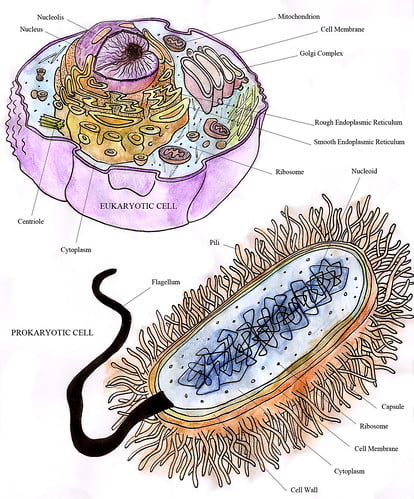
| Property | Prokaryotic Bacterial Cells | Eukaryotic Human Cells |
| DNA within a nuclear membrane | No | Yes |
| Number of chromosomes | 1 | More than 1 |
| Mechanism of Replication | Binary Fission | Mitosis |
| Presence of organelles, e.g. Golgi, mitochondria, lysosomes, endoplasmic reticulum | No | Yes |
| Size of Ribosome | 70S | 80S |
| Site of respiratory electron transport | Cytoplasmic membrane | Mitochondria |
| Cell wall containing peptidoglycan | Yes (except Mycoplasma) | No |
| Cell membrane containing sterols | No (except Mycoplasma) | Yes |
Frequently Asked Questions
What are the key differences between prokaryotic and eukaryotic cells?
Prokaryotic cells, like bacteria, lack a nuclear membrane, meaning their DNA is not enclosed. They have a single chromosome and replicate through binary fission. These cells do not have organelles like mitochondria or Golgi apparatus, and their ribosomes are smaller (70S). In contrast, eukaryotic cells, such as human cells, have DNA within a nuclear membrane, multiple chromosomes, and replicate via mitosis. They contain organelles and have larger ribosomes (80S). Eukaryotic cells conduct respiratory electron transport in mitochondria, while in prokaryotes, it occurs in the cytoplasmic membrane.
Do prokaryotic cells have a cell wall?
Yes, most prokaryotic cells have a cell wall containing peptidoglycan, which provides structural support and protection. However, there are exceptions like Mycoplasma, a genus of bacteria that does not have a cell wall. This structural feature distinguishes them from eukaryotic cells, which typically do not have a peptidoglycan-containing cell wall.
What role do sterols play in cell membranes?
Sterols, such as cholesterol in human cells, are important components of eukaryotic cell membranes. They help maintain membrane fluidity and stability, allowing for proper cell function and communication. In most prokaryotic cells, sterols are absent, except for some like Mycoplasma. The absence of sterols in prokaryotes affects their membrane characteristics and functions differently compared to eukaryotic cells.
How do prokaryotic cells replicate?
Prokaryotic cells replicate through a process called binary fission. In this simple method, the single chromosome is duplicated, and the cell divides into two genetically identical daughter cells. This process is quick and efficient, allowing prokaryotes to multiply rapidly under favorable conditions. This contrasts with eukaryotic cells, which use the more complex process of mitosis involving multiple chromosomes and distinct phases.
Why are ribosome sizes different in prokaryotes and eukaryotes?
Ribosomes, the cellular machinery for protein synthesis, differ in size between prokaryotes and eukaryotes. Prokaryotic ribosomes are smaller, 70S, while eukaryotic ribosomes are larger, 80S. The 'S' stands for Svedberg units, a measure of sedimentation rate during centrifugation. These differences are not just structural but also affect the sensitivity to antibiotics, which often target bacterial ribosomes without affecting eukaryotic ones.
Where does electron transport occur in prokaryotic cells?
In prokaryotic cells, the electron transport chain is located in the cytoplasmic membrane. This contrasts with eukaryotic cells, where electron transport occurs in the mitochondria. The location of the electron transport chain is crucial for generating ATP, the energy currency of the cell, through oxidative phosphorylation. This fundamental difference highlights the adaptations of prokaryotic cells to their simpler structure.